

VibePaper
An AI-powered collaborative workbench for short drama production teams, featuring a node-based infinite canvas.
标签:AI Video ToolsAI video toolsWhat is VibePaper?
VibePaper is an AI collaboration workbench for short drama production companies and professional creators. While others’ canvases only contain you, VibePaper’s canvas includes you and an AI team—four agents: planning, scriptwriting, visual design, and editing, each with its own role. Driven by top-tier models such as Gemini 3.1 Pro, GPT-5.4, Claude Opus 4.6, Seedance 2.0 , and Kling 3.0 Omni, they collaborate transparently on an infinite, node-based canvas. It supports various creative needs, including AI-generated animated series and commercials, creating a closed loop from script to final product within a single canvas. AI handles all execution, while the core team is responsible for the final touches.
VibePaper’s main functions
- AI-powered scriptwriting : Driven by mainstream large language models such as Gemini 3.1 Pro, with strong contextual capabilities throughout the entire process. Input your creative direction or upload a reference script, and it will automatically generate a structured script that includes character settings, scene descriptions, and episode plots. It supports multiple creative paths, including comics (mainstream genres such as urban, historical, suspense, and romance) and commercial films (product selling point analysis, brand advertising scripts).
- AI Storyboarding : Automatically breaks down each shot into its own storyboard based on the script, plans the composition, character positioning, camera movement, and transition effects, and outputs a structured storyboard table, including three-view drawings of the characters and multi-camera scheduling schemes. The storyboarding logic for comics and commercial films has been optimized separately.
- Linear Image Generation : Integrates image models such as GPT-Image-2, Banana Pro, and Seedream 5.0. Reference images are directly connected to generated nodes, accurately conveying character appearance and scene style, ensuring visual consistency of characters, scenes, and props throughout the entire animated series and commercial films. Any node can be modified and re-run without affecting other nodes.
- Continuous video generation : Integrates video models such as Seedance 2.0, Kling 3.0 Omni, and Veo 3.1. It converts storyboards or images into high-quality, coherent videos, supporting various styles including animated series and human-like dramas. Commercial films can utilize the most suitable model based on the product scenario.
- Video post-processing : Built-in super-resolution, video splicing and editing functions allow you to complete post-processing directly on the canvas without exporting to third-party tools.
- AI Dubbing and Subtitles : Built-in AI dubbing and subtitle generation, supports multiple language versions, and outputs vertical high-definition videos that can be directly published to Douyin, Kuaishou, and Xiaohongshu.
- Canvas auxiliary tools : Built-in high-frequency and practical functions such as image expansion, one-click cropping to a nine-grid layout, and image cropping, covering small needs throughout the entire production process.
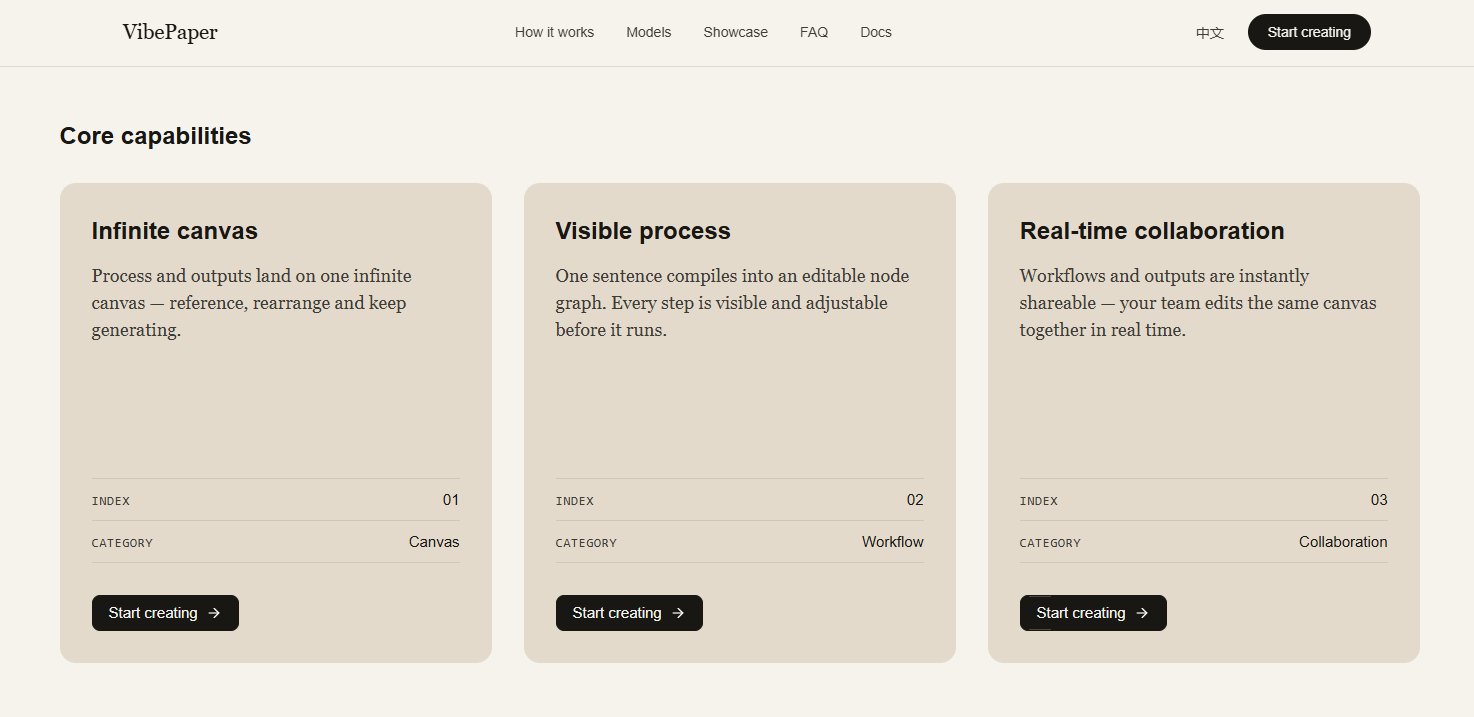
- Team co-creation canvas : Multiple people share the same canvas, and data, versions, and modification history are centrally visible. New members can understand the overall picture of the project as soon as they open the canvas.
- Memory Accumulation : Brand tone, visual guidelines, and historical projects are accumulated into the team’s long-term memory, which can be directly accessed by the agent, and creative experience is not lost with personnel changes.
- Mass production line : After the workflow is successfully completed, save it as a template, replace the product, selling points or platform size, and output the images in batches. Vertical, horizontal and square versions can be adapted with one click.
How to use VibePaper
- Access the platform : Open the webpage https://vibepaper-ai.com/, register an account, enter the canvas, and start with a blank canvas or a template.
-
Input creation goal : The scriptwriter agent selects a suitable large language model to break down the brief and generate a structured script.
-
Generating storyboards : The storyboard agent automatically disassembles the storyboard table according to the script, reworks unsatisfactory nodes individually, and retains the rest.
-
Generate and adjust the visuals : Connect the reference diagram, the visual agent generates the scene according to the storyboard, and each shot can be finely adjusted independently without affecting other nodes.
-
Video Production : Video Agent converts images or storyboards into a coherent video, with built-in post-production tools for editing, super-resolution, dubbing, and subtitles.
-
Save Template : Save the workflow as a template so the team can reuse it directly next time, or replace the content to generate videos in batches.
Key information and usage requirements for VibePaper
- Product positioning : An AI-powered collaborative workbench for short drama production companies and professional creators.
- Core Format: Node-based infinite canvas + four-agent collaboration.
- Driver models : Gemini 3.1 Pro, GPT-5.4, Claude Opus 4.6, Seedance 2.0, Kling 3.0 Omni, etc.
- Main application scenarios : AI-generated animated series, humanoid short dramas, and commercials.
- Billing model : Monthly subscription, supporting monthly membership, points purchase, and enterprise services.
- Team features : shared canvas, multi-person collaboration, and version traceability.
- Platform compatibility : Douyin, Kuaishou, Xiaohongshu, Bilibili; one-click switching between vertical and horizontal layouts.
VibePaper’s product pricing
It offers monthly subscription options and supports three payment methods: monthly membership, points purchase, and enterprise services.
- Basic : 79 RMB per month, 490 points per month, maximum of approximately 245 images/61 videos. Generates concurrently x4, unlocks Paper Agent; Text models: Gemini 3.1 Pro, Gemini 3.0 Flash, GPT-5.4, Claude Opus 4.6, Claude Sonnet 4.6, Kimi K2.5, Seed 2.0 Mini; Image models: Imagen 3 series, GPT-Image-2, Wan 2.7 Image Pro, Seedream 5.0, Midjourney V7; Video models: Seedance 2.0, Seedance 2.0 Fast, Kling 3.0 Omni, Vidu q3 Pro, Wan 2.7, Veo 3.1.
- Pro : 199 RMB per month, 1260 points per month, up to approximately 630 images/157 videos. Generates concurrently by 8, unlocks Paper Agent; text, image, and video models are the same as above.
- Pro+ : 419 RMB per month, 2800 points per month, up to approximately 1400 images/350 videos. Unlimited concurrency, unlocks Paper Agent; text, image, and video models are the same as above.
- Ultra : 819 RMB per month, 5600 points per month, up to approximately 2800 images/700 videos. Unlimited concurrency, unlocks Paper Agent; text, image, and video models are the same as above.
- Enterprise services support customized solutions; please contact the official website for a quote.
VibePaper’s core advantages
- Node-level rework : If a shot is modified, only that node needs to be re-run, without affecting the rest of the content. Repeated polishing avoids jeopardizing the entire film.
- Consistency through Connections : Direct connections are made between reference images and generated nodes, ensuring that character appearances and scene styles are locked throughout the entire process, and that the visuals of the entire comic series and commercial films remain consistent.
- The AI team is divided into four agents: planning, scriptwriting, visual design, and editing. Each agent performs its own function, driven by a top-tier large language model, and the process is transparent and can be intervened in.
- Team memory preservation : Brand standards, production experience, and past projects are preserved in the canvas, allowing newcomers to get started quickly and enabling team expansion without starting from scratch.
- The entire process is completed within a single canvas : From script to final product, images, videos, post-production, voice-over, and subtitles are all done within a single canvas, without switching tools or losing context.
Application scenarios of VibePaper
- Short drama production company : Multiple people work together, with planners, screenwriters, visual designers, and editors working in parallel to advance the project. Style standards are established and become part of the team’s identity, allowing for the mass production of series content and enabling newcomers to quickly get started.
- Professional short drama creators : Four agents supplement the execution side manpower, while the creators retain control over every key decision. The entire process of comic strips and humanoid dramas is completed on a single canvas.
- Commercial advertising team : Connect and reuse brand visual assets, break down product selling points into scripts, adapt multiple versions to different platforms, and produce videos in batches.
Frequently Asked Questions about VibePaper
A: Traditional tools focus on single-point generation from “input prompt → output video,” while VibePaper provides a complete workflow from brief to final product. It breaks down creation into independently editable nodes (scripts, storyboards, shots, voice-over, etc.), allowing you to redo only the steps you need to change, and supports multi-agent collaboration and team template reuse, making it more suitable for teams that require fine-grained control and mass production.
A: Yes. In a node-based architecture, each element (script, storyboard, individual shot, voice-over track, etc.) is an independent node. When modifying the shot at the 51st second, the node state of the previous 50 seconds remains unchanged. The Agent only regenerates for that node, and the overall chain is not disrupted.
A: The platform integrates mainstream video generation models. The visual agent will automatically select the most suitable model based on the current scene. For the complete list of supported models, please refer to the official website for real-time updates.
A: Multiple users can collaborate in real time around the same canvas, with centralized management of data, versions, and decisions. For specific team permissions and billing models, please refer to the official website’s pricing scheme.
相关导航