




AI Development Platform
MLX
Apple has released an open-source machine learning framework designed specifically for Apple Silicon chips.
标签:AI Development PlatformAI development platformWhat is MLX?
MLX is an array framework for machine learning developed by Apple’s machine learning research team. This open-source framework is designed and optimized for Apple Silicon chips, drawing inspiration from frameworks such as NumPy, PyTorch, Jax, and ArrayFire. It provides a simple and user-friendly interface, helping developers effectively develop, train, and deploy models on Apple’s M-series chips. MLX supports multi-device operation (such as CPU and GPU) and uses a unified memory model, eliminating the need to copy data between devices.
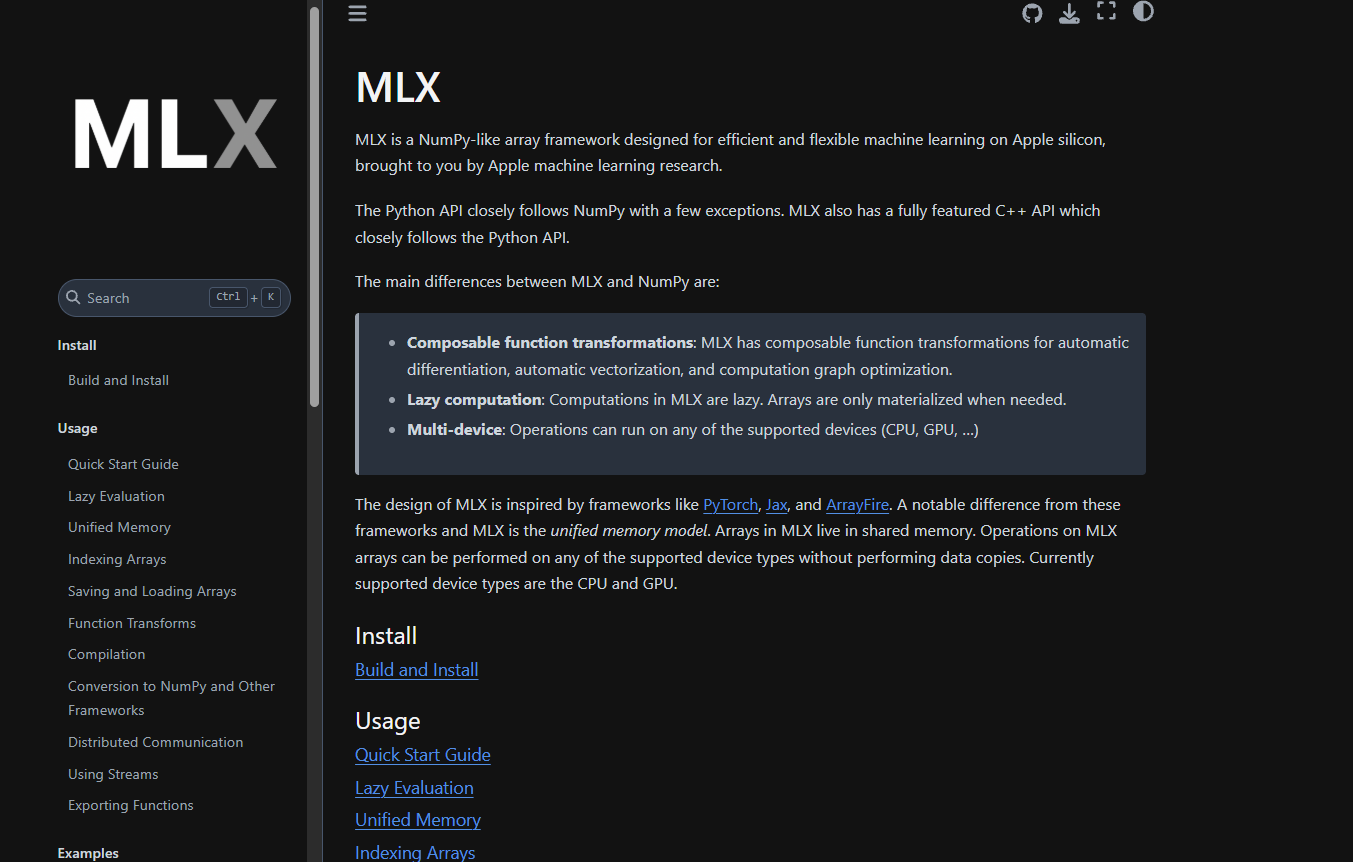
MLX’s main functions
- Familiar API : MLX follows closely behind NumPy’s Python API. MLX has a fully functional C++ API that is very similar to the Python API.
- Composable function transformations : MLX supports composable function transformations for automatic differentiation, automatic vectorization, and computational graph optimization.
- Lazy computation : Computation in MLX is lazy computation; arrays are only materialized when needed.
- Dynamic graph construction : The computation graph in MLX is constructed dynamically. Changing the shape of function parameters does not trigger slow compilation, and debugging is simple and intuitive.
- Multi-device : Can run on any supported device (CPU and GPU).
- Unified Memory : The main difference between MLX and other frameworks lies in its unified memory model, where arrays share memory. Operations on MLX can run on any supported device type without moving data.
How to use MLX
-
Install MLX : Install the MLX library using a package management tool.
-
Import the library : Import the MLX library into your Python script to start using the features.
-
Creating arrays : Use MLX’s array creation functions, similar to NumPy’s, to create data structures for machine learning.
-
Perform operations : Use the rich set of operation functions provided by MLX to perform calculations and transformations on the array. The operations will automatically take advantage of features such as deferred computation and automatic differentiation.
-
Device management : Assign operations to different devices (such as CPU or GPU) as needed, and MLX automatically handles communication between devices.
-
Model building : Build machine learning models using MLX, and improve model efficiency by leveraging automatic vectorization and computational graph optimization features.
-
Training and optimization : The model is trained and optimized using the optimizer and training loop provided by MLX.
-
Save and Load : Save the trained model or data to a file, or load it from a file for later use.
MLX official website address
- Official website : https://ml-explore.github.io/mlx/build/html/index.html
- GitHub repository : https://github.com/ml-explore/mlx
MLX application scenarios
-
Deep learning model training : Train various deep learning models, such as CNN and RNN. Automatic differentiation and vectorization functions can improve training efficiency.
-
Data Analysis and Processing : MLX supports multi-device operation, can efficiently process large-scale datasets, and is suitable for data preprocessing and feature engineering.
-
Scientific research : In physical simulations and bioinformatics, MLX can be used to build and optimize complex computational models, such as molecular dynamics simulations and gene sequence analysis.
-
Industrial applications : MLX can be used for equipment failure prediction and production process optimization in smart manufacturing, as well as energy consumption prediction in energy management.
-
Image and video processing : MLX can be used to build image classification and video analysis models, such as object detection and behavior recognition.
相关导航





ai-navhub:The official website of the AI Toolset includes hundreds of AI tools from both domestic and international sources, as well as commonly used websites, frameworks, and models for AI learning and development, helping you join the wave of artificial intelligence and complete tasks efficiently and automatically!