






AI Search Engine
Qdrant
Open-source vector databases and vector similarity AI search engines
标签:AI Search EngineAI search engineWhat is Qdrant?
Qdrant is an open-source vector database and vector similarity AI search engine, founded by Andre Zayarni in Berlin, Germany in 2021. Developed using the Rust programming language, it supports the efficient conversion of multi-modal data into vectors for storage and retrieval. With its high performance and low storage requirements, Qdrant is widely used in personalized recommendations, text and image recognition, and real-time data analysis. In January 2024, Qdrant completed a $28 million Series A funding round, led by Spark Capital.
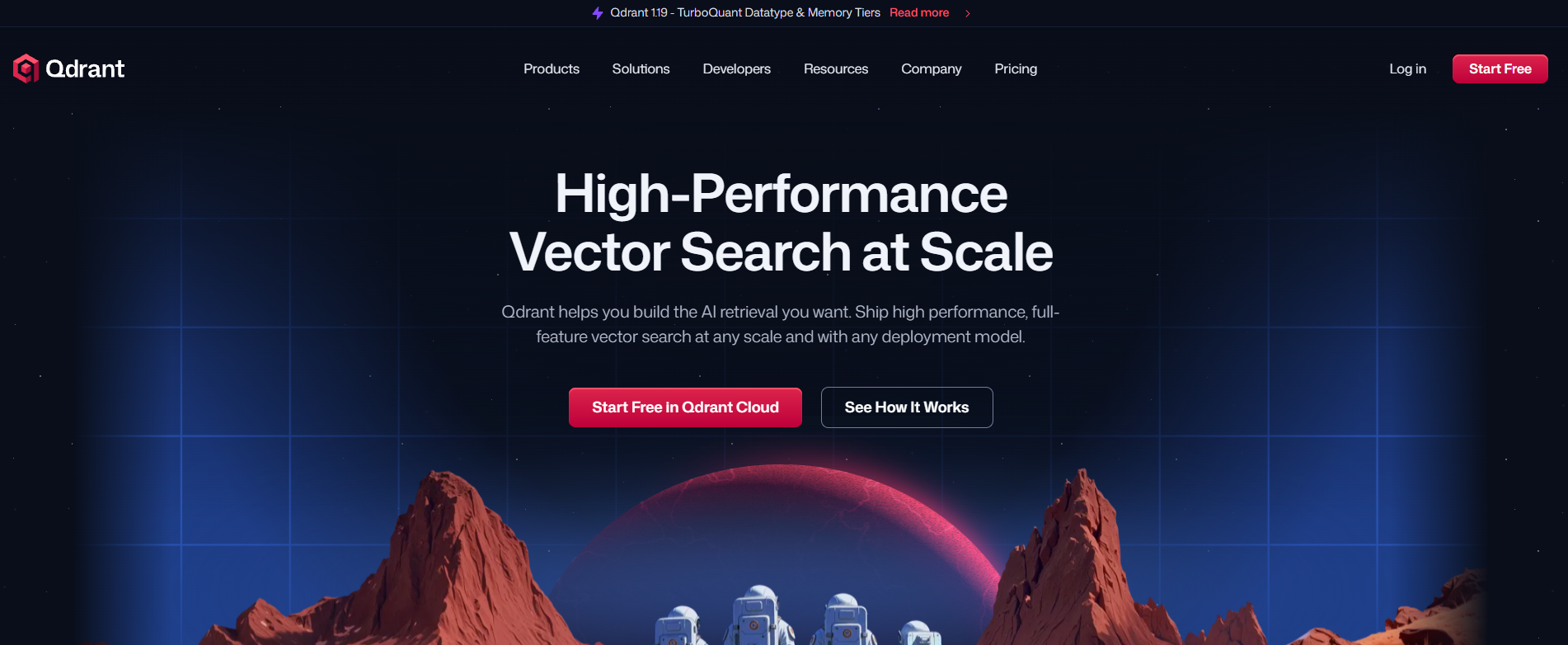
Qdrant’s main functions
-
Vector storage : Qdrant can efficiently store high-dimensional vector data, making it suitable for processing large-scale datasets.
-
Similarity search : Users can quickly retrieve vectors similar to the input vector, which is very useful in recommendation systems and content matching.
-
Multimodal data processing : Supports the conversion of data of different modalities such as text, images, audio and video into vectors, enabling cross-modal search and analysis.
-
Real-time search : Provides fast search capabilities, suitable for application scenarios that require real-time feedback.
How to use Qdrant
- Access website: Visit the Qdrant official website ( qdrant.tech ).
-
Installing Qdrant : Pull the Qdrant image using Docker and run it.
-
Installing the Qdrant client : Installing the Python client via pip
-
Initialize the Qdrant client : Initialize the Qdrant client and connect to the Qdrant service in Python.
-
Creating a Collection : Creates the collection schema and creates the collection in Qdrant.
-
Inserting vector data : Inserting vector data into a set
-
Creating an index : Creating an index using a Python client
-
Search vector : Runs basic search queries
-
Clean up resources : After completing the operation, clean up the resources to ensure that system resources are released.
Application scenarios of Qdrant
-
Image recognition : In the field of computer vision, Qdrant can convert images into vectors and quickly retrieve similar images, making it suitable for large-scale image recognition tasks.
-
Natural Language Processing : Qdrant can be used for text analysis, such as document classification and sentiment analysis, and finds semantically similar text through vector search.
-
Real-time data analysis and monitoring : Qdrant provides fast retrieval capabilities, suitable for data analysis and monitoring scenarios that require real-time feedback.
-
Hybrid Search : Combining sparse and dense vector search to achieve rich query responses, suitable for scenarios that require combining keyword and semantic search.
-
Metadata filtering : Qdrant supports metadata filtering, which makes it very useful when processing queries that contain additional information, such as responding immediately based on user descriptions in a shopping assistant.
相关导航


ai-navhub:The official website of the AI Toolset includes hundreds of AI tools from both domestic and international sources, as well as commonly used websites, frameworks, and models for AI learning and development, helping you join the wave of artificial intelligence and complete tasks efficiently and automatically!