






brilliant
What is an introduction to neural networks?
Introduction to Neural Networks is an online course that introduces artificial neural networks. Through hands-on experiments rather than complex mathematical derivations, the course helps students dissect the internal mechanisms of neural networks and develop an intuition for the types of problems they are applicable to. The course content includes the basic principles of neural networks, how to learn and make decisions through pattern recognition, and their applications in real-world tasks. It is suitable for learners with some algebra and logic background; no programming experience is required. The course enables students to understand neural networks through practice, laying the foundation for in-depth learning of algorithms or building their own networks.
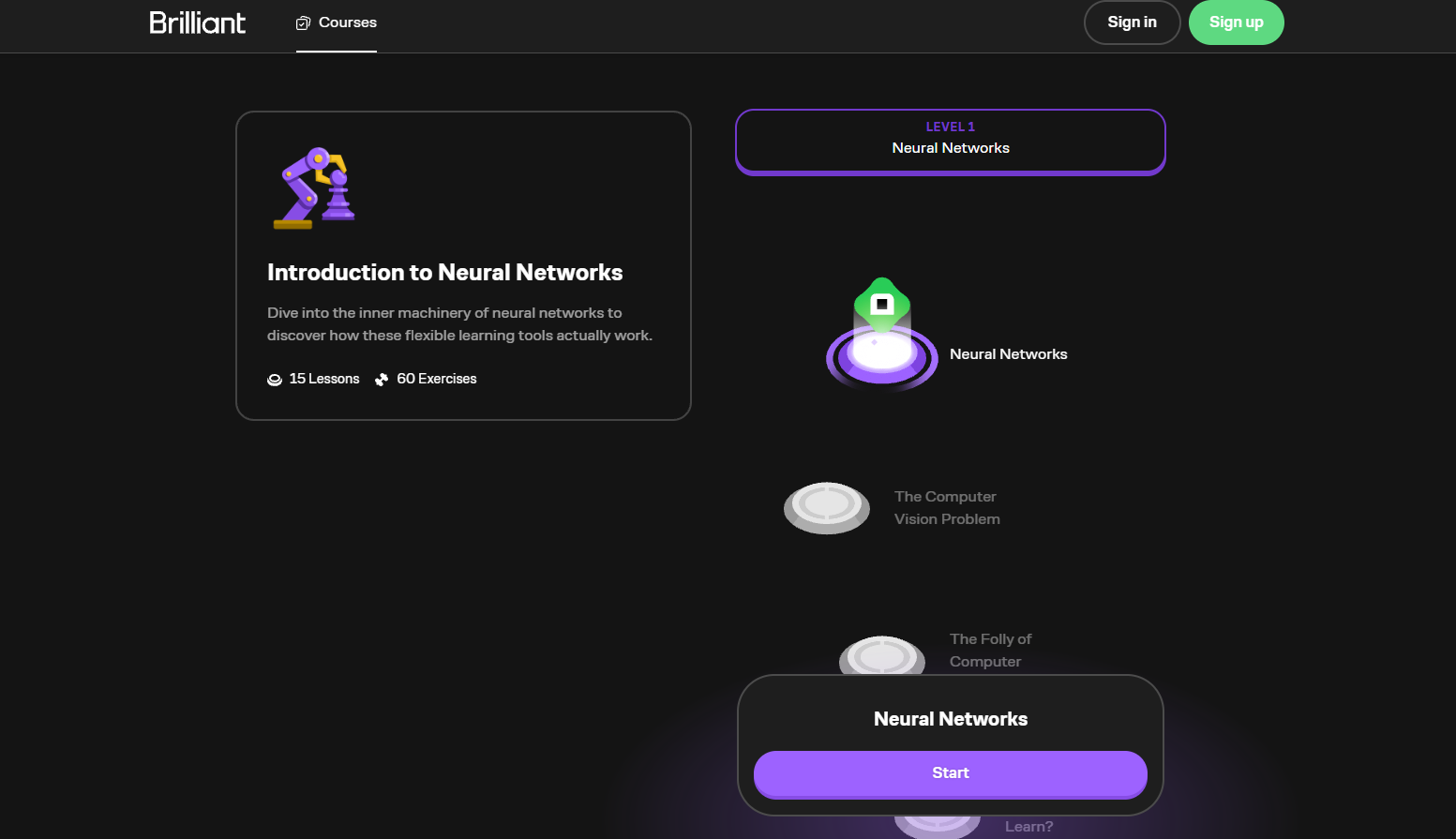
Main functions of neural network introduction
- Basic knowledge instruction : Explaining the basic structure and working principle of neural networks to help learners understand their core concepts.
- Practical skills development : Through hands-on experiments and programming exercises, learners’ ability to solve real-world problems is enhanced.
- Sparking learning interest : Using intuitive demonstrations and case studies, spark learners’ interest in and desire to explore neural networks.
- Laying the foundation for advanced learning : Providing learners with the necessary theoretical and skill reserves to help them delve deeper into deep learning and artificial intelligence.
- Cultivating innovative thinking : Encourage learners to try different architectures and parameter adjustments to foster innovation and independent problem-solving abilities.
How to get started with neural networks
- Registration and Login : Visit the Brilliant website and follow the prompts to complete the registration and login process.
- To select a course : Search for “Introduction to Neural Networks” on the homepage, click the course link to view details and join the course.
- Start learning : Click the “Start Course” button to learn the course content in sequence and complete the exercises or experiments in each chapter.
- Platform features : Use the note-taking function to record key points, participate in discussion forums, and track your learning progress.
- Further learning : Refer to the supplementary resources recommended in the course and try building your own neural network project.
- Engage with the community : Participate in platform challenges and competitions, and follow updates to get the latest course information.
Application scenarios for beginners in neural networks
- Image recognition : Classifying images using simple convolutional neural networks (CNNs), such as recognizing handwritten digits (MNIST dataset) or basic object classification.
- Speech recognition : Simple voice command recognition is achieved by processing audio data through simple recurrent neural networks (RNNs) or long short-term memory networks (LSTMs).
- Text generation : Use RNN or Transformer architectures to generate simple text content, such as poems or short articles.
- Sentiment analysis : Classifying text data by sentiment to determine whether the text is positive, negative, or neutral.
- Predictive analytics : Using neural networks to predict time series data (such as stock prices and weather data).
相关导航


