






AI Learning Website
Elements of AI
What are Elements of AI?
Elements of AI is a free online introductory course for beginners in AI, jointly offered by the University of Helsinki and Reaktor. The course popularizes artificial intelligence knowledge, helping people understand basic AI concepts, principles, and their applications in daily life. Elements of AI is suitable for anyone, requiring no complex mathematical or programming background. Course content includes the history of AI, the basics of machine learning, neural networks, and explores the impact of AI on society. The course uses a simple and easy-to-understand approach to help learners grasp the core ideas of AI and improve their understanding and application of cutting-edge technologies.
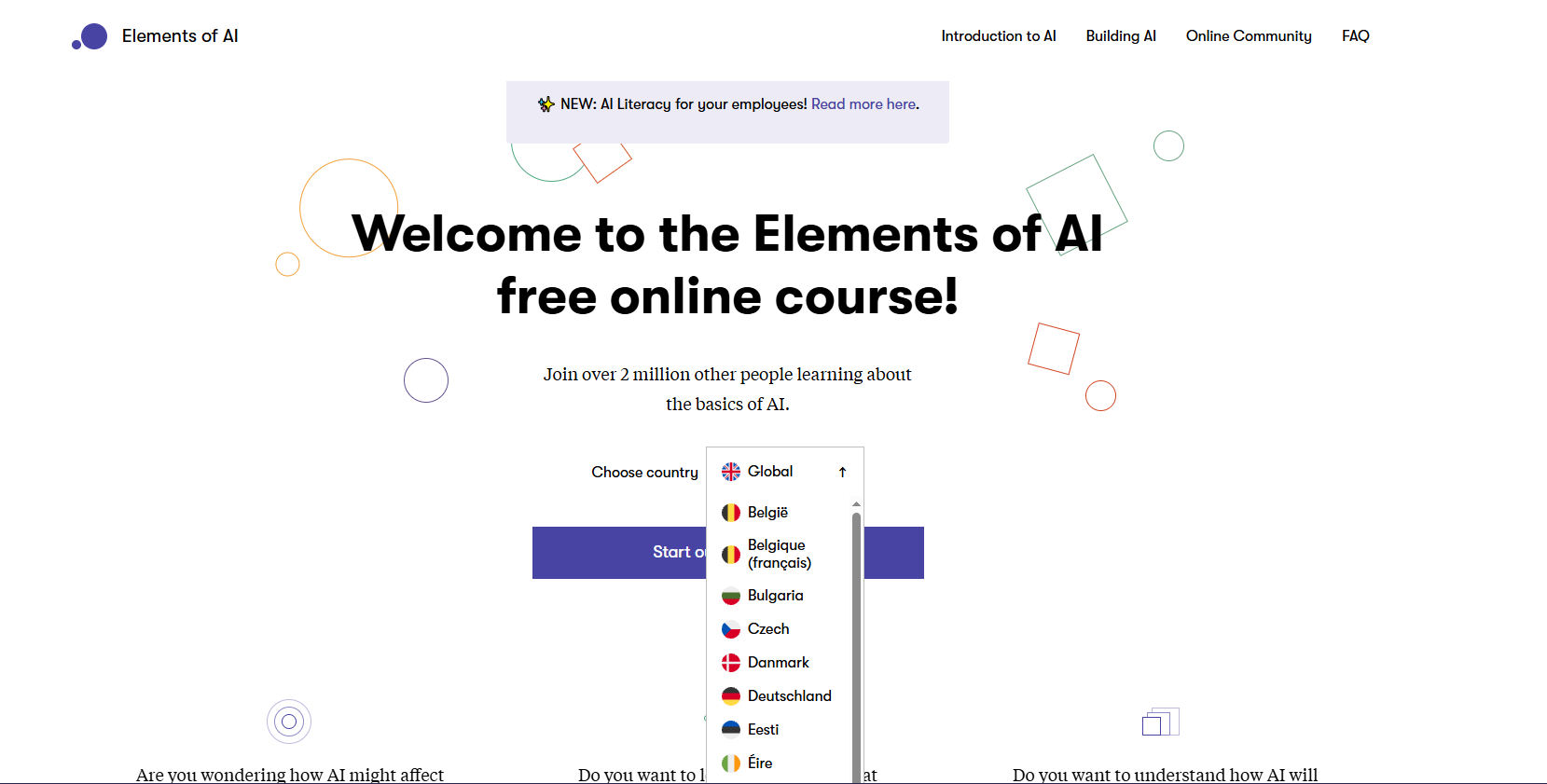
The main functions of Elements of AI
- Foundational Knowledge : The course covers the history, definition, key technologies (such as machine learning and neural networks), and practical applications of artificial intelligence, helping learners build a comprehensive understanding of AI.
- Interactive learning experience : Through online courses, combined with videos, reading materials, quizzes and practical exercises, learners can deepen their understanding through interaction.
- Multilingual support : The course is available in multiple languages to facilitate learning for people from different countries and regions, and promote the popularization of AI knowledge globally.
- Social Impact Discussion : This section explains the technical aspects of artificial intelligence and explores its impact on society, the economy, and ethics, helping learners to think comprehensively about the applications and challenges of AI.
- Free access : The courses are completely free, requiring no prior knowledge, lowering the learning threshold and allowing more people to access and learn about artificial intelligence.
Curriculum of Elements of AI
- Introduction to AI :
- What is AI?: This question explores the definition, history, relationship with other disciplines, and philosophical questions of artificial intelligence.
- AI problem solving : This section introduces search algorithms, problem-solving methods, and their applications in games.
- Real-world AI : This section discusses the application of probability, Bayesian rules, and Naive Bayes classifiers in real-world problems.
- Machine learning : Introduces the types of machine learning (supervised learning, unsupervised learning, reinforcement learning) and their applications.
- Neural networks : Introduces the fundamentals of neural networks, their construction methods, and deep learning techniques.
- Implications : This section explores the social, economic, and ethical impacts of artificial intelligence and its future trends.
- Building AI :
- Getting Started with AI : Introduces the importance of artificial intelligence, optimization problems, and hill-climbing algorithms.
- Dealing with uncertainty : Introduces the basics of probability, Bayesian rules, and the Naive Bayes classifier.
- Machine learning : Introduces linear regression, nearest neighbor methods, text processing, and overfitting.
- Neural networks : Introduces logistic regression, its extensions to neural networks, and deep learning.
- Conclusion : Summarize the course content, showcase participants’ ideas on artificial intelligence, and provide a platform for community exchange.
Application Scenarios of Elements of AI
- In the education sector : Providing basic knowledge of artificial intelligence to college students, working professionals, and online learners to help improve personal skills and career development.
- Corporate Training : Integrated into the enterprise LMS, it helps employees master artificial intelligence technologies, promoting enterprise digital transformation and cross-departmental collaboration.
- Government and public sector : Helping policymakers and civil servants understand artificial intelligence, optimize public services, and increase public acceptance of artificial intelligence.
- For those without a technical background : Providing introductory knowledge to individuals without a technical background, supporting personal interest-based learning and career transitions.
- Social and Ethical Discussion : Promoting public discussion on the ethics, privacy, and social impact of artificial intelligence, and providing a research foundation for ethicists and legal experts.
相关导航


ai-navhub:The official website of the AI Toolset includes hundreds of AI tools from both domestic and international sources, as well as commonly used websites, frameworks, and models for AI learning and development, helping you join the wave of artificial intelligence and complete tasks efficiently and automatically!