






AI Model Evaluation
PubMedQA
Biomedical research question-answering dataset and model score leaderboard
标签:AI Model EvaluationAI model evaluationWhat is PubMedQA?
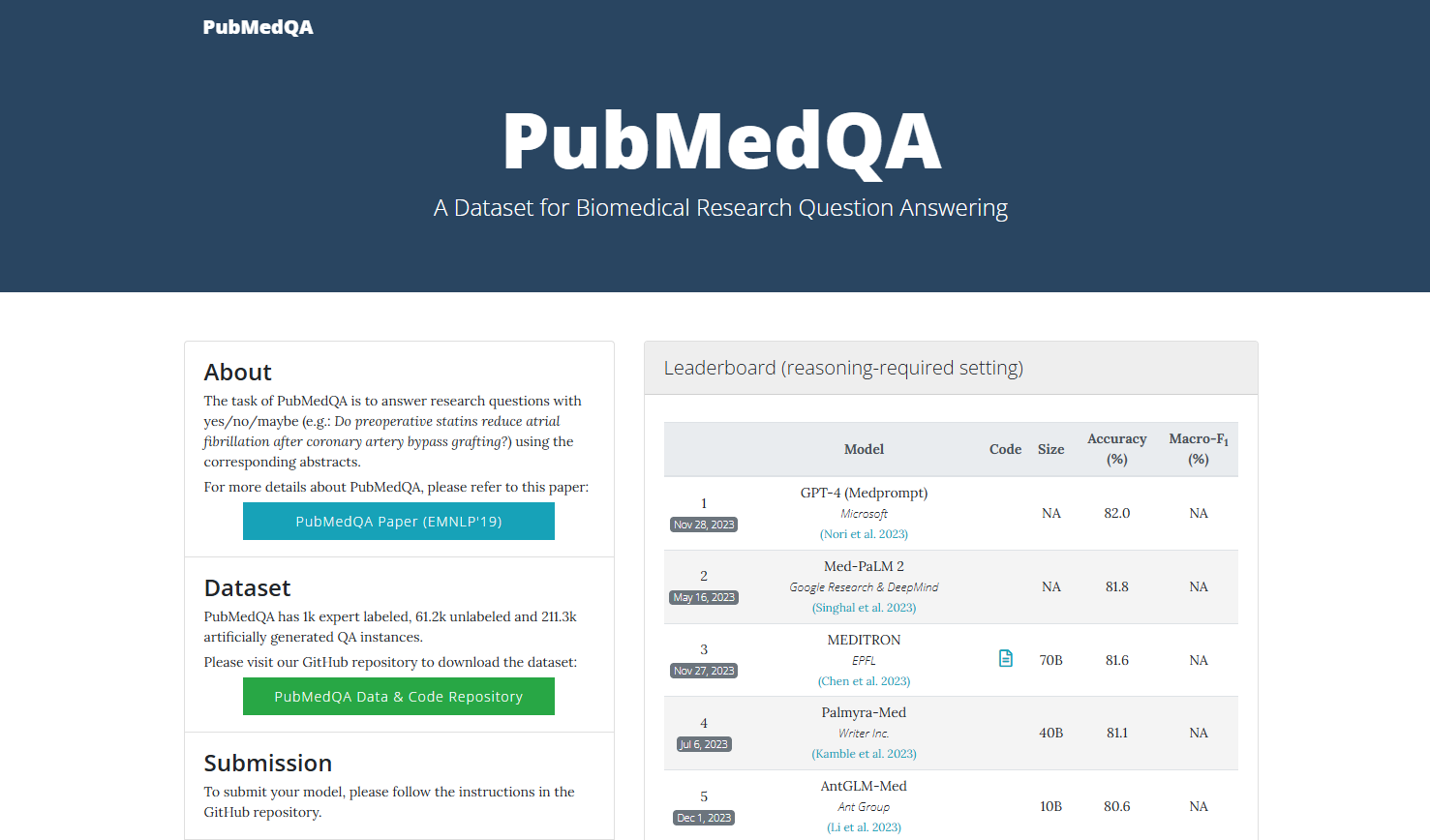
PubMedQA is a dataset specifically designed for answering questions in biomedical research. PubMedQA answers research questions in the form of “yes/no/possible” based on literature summaries, such as “Is a certain drug effective?”. The dataset contains 1000 expert-annotated question-and-answer instances, 61200 unannotated instances, and 211300 manually generated question-and-answer pairs. PubMedQA provides researchers with a standardized testing platform for developing and evaluating biomedical natural language processing models, helping to improve the models’ understanding and question-and-answer capabilities in biomedical literature.
PubMedQA’s main functions
- PubMedQA provides a high-quality biomedical question-answering dataset , containing 1,000 expert-annotated question-answer pairs, 61,200 unannotated question-answer pairs, and 211,300 manually generated question-answer pairs, offering rich data resources for biomedical natural language processing research.
- As a benchmark platform for model evaluation , PubMedQA provides standardized testing benchmarks for biomedical question-answering models. By publishing performance metrics of different models, it helps researchers compare and improve their models.
- Supporting efficient information extraction in biomedical research : Datasets facilitate biomedical natural language processing research, enabling the rapid extraction of key information from massive amounts of literature and improving research efficiency.
- Advancing the development of biomedical natural language processing technology : PubMedQA provides high-quality data to promote the advancement of technologies such as biomedical question answering systems and text understanding, laying the foundation for developing more intelligent artificial intelligence models.
How to use PubMedQA
- Download the PubMedQA dataset : Visit the PubMedQA GitHub repository: https://github.com/pubmedqa/pubmedqa, clone the repository and download the dataset file.
- Understanding the dataset structure : Load the dataset file, view its structure, and learn about the questions, answers, and related literature abstracts contained in each instance.
- Data preprocessing : Preprocess the data, such as using a tokenizer to convert the question and summary into a format acceptable to the model, extracting tags, etc.
- Training the model : Select a suitable model architecture (such as BERT, PubMedBERT, etc.), train the model with the preprocessed data, and optimize the model parameters to improve performance.
- Model evaluation : Evaluate the model’s performance on the test set, calculate metrics such as accuracy and F1 score, and verify the model’s effectiveness.
- Submit to the leaderboard : Following the “Submission” guidelines in the GitHub repository, submit the model’s prediction results and performance metrics to the PubMedQA leaderboard and wait for review.
- Optimize your model by referencing leaderboards : Review the performance and methods of high-scoring models on the leaderboard, compare them with your own model, and further optimize your model.
Application scenarios of PubMedQA
- Clinical decision support : Helps doctors quickly access the latest research findings to assist in diagnostic and treatment decisions.
- Medical research : Provides researchers with literature information to accelerate the research process.
- Medical education : as a learning tool, it helps medical students quickly acquire biomedical knowledge.
- Drug development : Supporting pharmaceutical companies and researchers to quickly understand drug efficacy and clinical trial results.
- Intelligent medical system : Integrated into the intelligent medical platform, providing users with personalized medical advice based on the latest research.
相关导航


ai-navhub:The official website of the AI Toolset includes hundreds of AI tools from both domestic and international sources, as well as commonly used websites, frameworks, and models for AI learning and development, helping you join the wave of artificial intelligence and complete tasks efficiently and automatically!