

Neural4D
AI-powered one-stop 3D model generation platform
标签:3D Model Generation AI Image ToolsAI 3D model generationWhat is Neural4D?
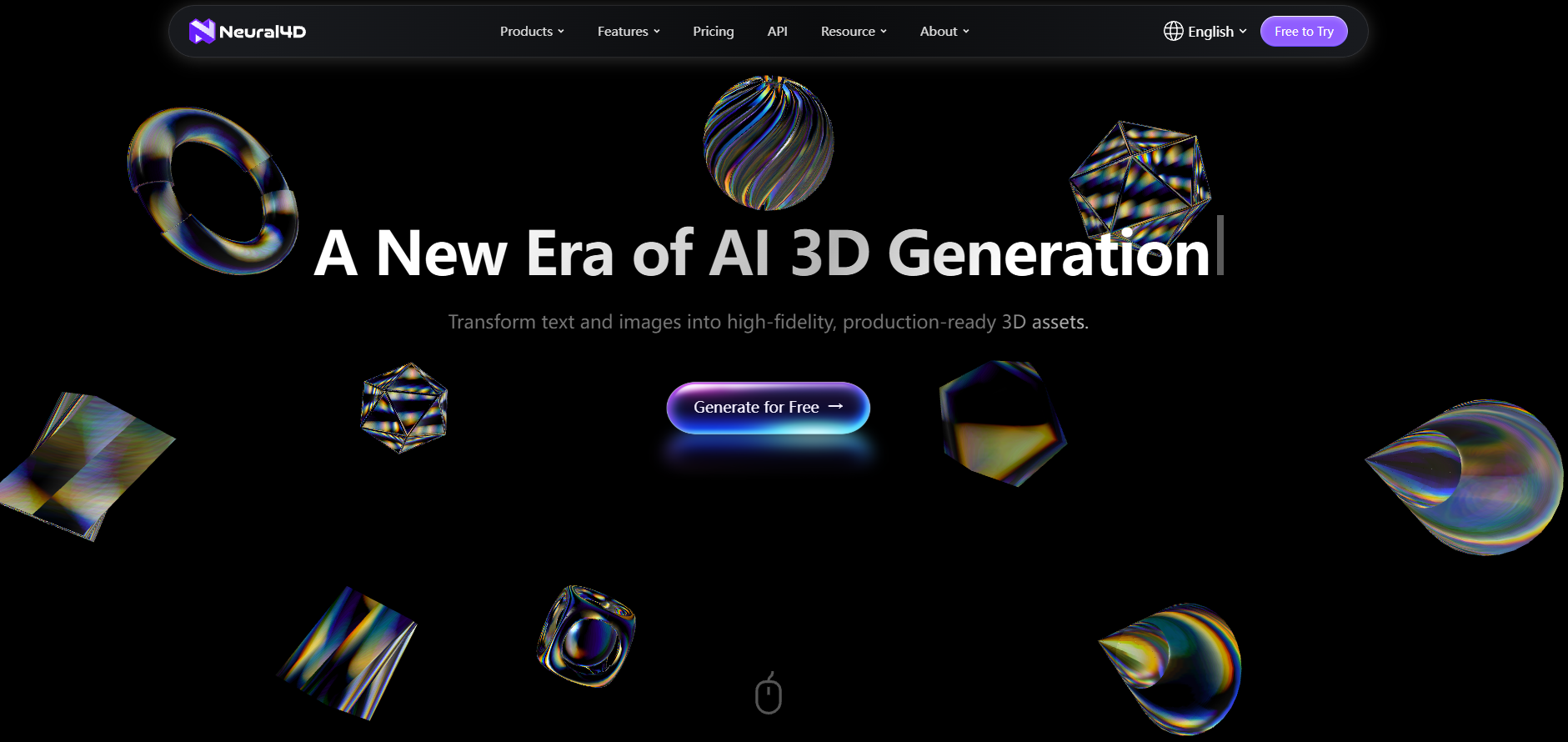
Neural4D is an AI 3D model generation platform developed by the DreamTech team (which brings together research talent from top universities such as Oxford University and Nanjing University). Based on the globally leading Neural4D-2.5 large model, it can quickly generate high-quality 3D models and animations from text descriptions or image inputs. It supports a resolution of tens of millions of polygons and is the first to achieve 3D model generation with 1 million tokens. It can complete high-precision model inference within 1.5 minutes, demonstrating extremely high efficiency. Neural4D possesses native 3D texture generation capabilities and powerful generalization abilities, supports regular images, and can process emojis, simple drawings, and other expressive elements. Its generation results outperform those of major European and American companies in multi-scenario evaluations.
Main functions of Neural4D
-
High-precision 3D model generation : Supports a level of detail of tens of millions of faces, and for the first time achieves the generation of 3D models with 1 million tokens. It can complete high-precision model reasoning within 1.5 minutes, making it suitable for complex scenes and high-detail requirements.
-
Multimodal interaction : Users can generate 3D models by describing them with text or uploading images. The platform supports natural language dialogue interaction and allows for real-time fine-tuning of the generated model’s details, such as changing colors and adjusting proportions.
-
Native 3D texture generation : Avoids the spatial inconsistency problem of traditional 2D texture mapping, achieves the best 3D geometry and texture effects, and improves the realism and visual quality of the model.
-
Powerful generalization capabilities : Supports regular images, can process emojis, simple drawings, fluffy floating particles and other expressive elements, generate high-quality 3D models, and adapt to various input styles.
-
Production optimization : Optimize geometric algorithms for 3D printing and CNC engraving to solve pain points in physical production such as manifold thickening and structural smoothing. The generated models can be directly used for physical manufacturing.
-
High cost-effectiveness : The API call cost is low, about 0.51 yuan per call, and the computing power requirement is only 1/5 of that of the traditional model, which greatly reduces the hardware threshold and is suitable for individual and professional users.
-
Multi-scenario applications : The generated 3D models support multiple mainstream formats (such as OBJ, GLB, STL) and can be directly used in software such as 3D printing, game engines (Unity/Unreal), and Blender. They are widely used in game development, film and television production, education, industrial design and other fields.
How to use Neural4D
-
Register/Login : Visit the Neural4D official website https://www.neural4d.com/ and click “Start” to register an account. New users will receive 600 points upon registration, which can be used to generate 10 models.
-
Choose the generation method : After entering the platform, select the “Text-to-3D” or “Image-to-3D” mode.
-
Wensheng 3D : Enter a description in the “Magic Hint” box (e.g., “A cute cartoon dragon with its wings spread”).
-
Image-based 3D : Upload reference images (supports JPG, PNG, and other formats).
-
Neural4D-2.5 : A multimodal large model that supports text and image input, enabling real-time interactive editing, generation, and modification of models based on natural language.
-
-
Click to generate : After completing the input, click the “Generate” button. Generation time typically ranges from 30 seconds to 2 minutes, depending on the model complexity. A high-precision model with 1 million tokens takes approximately 1.5 minutes.
-
Adjusting the model : After generating the model, you can use the toolbar provided by the platform to adjust the model’s details, materials, or colors. You can also make fine adjustments through natural language dialogue commands, such as “make the corners sharper”.
-
Export Model : After satisfactory adjustments, the model can be exported to mainstream 3D formats such as OBJ, GLB, and STL, which can be used in 3D printing, game engines (such as Unity/Unreal), or Blender software.
-
Preview and Application : Supports mobile web login and VR functionality to place the generated 3D model in a real environment for preview, allowing users to intuitively experience the model’s effects.
Application scenarios of Neural4D
-
Game Development : Quickly generate characters, scenes, and props in games, shortening the time for creating art assets and accelerating the game development process.
-
Film and animation production : Generate high-quality 3D models and animations from text descriptions or images for special effects production or preview, reducing the cost of live-action shooting and the difficulty of post-production compositing.
-
3D Printing : Optimized geometric algorithms ensure that the generated models are suitable for 3D printing, and users can directly export them in STL format for physical manufacturing.
-
Industrial Design and Architectural Visualization : Quickly generate 3D models of products or simulated scenes of sunlight and pedestrian flow in buildings to assist in design evaluation and client communication.
-
Education and Research : Helping students and teachers better understand complex structures for use in teaching demonstrations or research simulations.
-
Virtual Reality (VR) and Augmented Reality (AR) : Creating immersive virtual spaces and dynamic elements to enhance the user experience.
Frequently Asked Questions (FAQ)
Q: How much does it cost to generate a model?
A: According to the official website, new users receive bonus points upon registration, which can be generated for free. The API call cost is approximately 1 yuan per call, making it more cost-effective than most AI 3D tools.
Q: What types of image input are supported?
A: Supports the vast majority of image types, including photos, illustrations, design drafts, and even emojis and simple drawings. It is especially optimized for “freehand” style images (such as fluffy or scattered particles).
Q: Can the generated model be used directly for 3D printing?
A: Yes. Neural4D has optimized its geometry algorithms specifically for 3D printing, ensuring that the model is manifold and has uniform thickness. After exporting to STL format, it can be directly imported into slicing software.
Q: How fast is the generation speed?
A: Depending on the model complexity, it usually takes between 30 seconds and 2 minutes to complete. A high-precision model with 1 million tokens takes about 1.5 minutes.
Q: Does the model support modification?
A: Yes. The Neural4D-2o version can be fine-tuned through natural language dialogue interaction, such as changing colors, adjusting proportions, and adding details.
Q: Is there a mobile version?
A: Supports mobile web login, and the VR function can be used to place the generated 3D model in a real environment for preview.
Q: How can I earn more points or discounts?
A: Follow our official social media accounts for limited-time events that offer points. Fans of our partner influencers can use an exclusive redemption code to receive an extra 500 points.
Experience suggestion: Start with simple emojis or clear photos of objects to experience its rapid generation and high fidelity. Suitable for 3D printing enthusiasts, game developers, animators, and anyone looking to lower the barrier to entry for 3D creation.
相关导航